
Chest pain does not always mean a heart attack, but it is one of the most alarming experiences an individual can face. Whenever anyone suffers from chest discomfort, the first question that strikes is whether it is related to stress, indigestion or a heart attack.
The challenge that lies in detecting heart-related symptoms is that they are at times mild and unusual, which makes it difficult for doctors to identify if it is just a minor pain or a cardiac arrest.
In Bardhaman and surrounding areas, where access to advanced cardiac care has improved a lot over the years, the coronary angiogram has become a vital diagnostic tool. The test helps decide whether chest pain is due to angina caused by temporary reduced blood flow or a heart attack resulting from complete blood flow blockage.
Chest pain: Is it always a heart attack?
Chest pain is a general symptom with multiple causes. It can arise from several problems, like muscle strain, acidity, anxiety and lung problems. Additionally, chest pain is a warning sign of acute coronary syndrome, which occurs when there is a sudden reduction of blood flow to the heart muscles.
On the other hand, a heart attack occurs when blood flow to the heart muscle becomes completely blocked or severely reduced. It happens due to plaque buildup inside a coronary artery followed by the formation of a blood clot. If the blood supply is not restored quickly, heart muscle can become damaged.
The difficulty is that the symptoms of a heart attack can sometimes be mistaken for less serious problems. At times, some patients dismiss the symptoms of a heart attack as just stress. This delays treatment, which often leads to an emergency. Thus, if you suspect any discomfort in your chest, get your heart attack symptoms evaluated in Bardhaman at Ahad Multispeciality Hospital.
Chest pain and heart attack: Key differences explained
Let’s take a look at the symptoms that differentiate less serious chest pain from a serious cardiac arrest.
Nature
Chest pain: Sharp, localised, and changes with movement or breathing. The discomfort can increase in intensity after pressing the affected area or nearby muscles.
Heart attack: Dull pressure or heaviness that remains the same with position changes. The pain might spread to the jaw, neck, shoulders, back, or left arm.
Duration
Chest pain: Improves when the underlying trigger, like acid reflux or muscle ache, goes away.
Heart attack: Persists for several minutes and tends to worsen.
Accompanying symptoms
Chest pain: Acidity, heartburn, bloating, coughing and breathing problems.
Heart attack: Sweating, nausea, shortness of breath, lightheadedness, unusual fatigue and weakness.
Onset
Chest pain: Occurs after meals, physical exertion, stress or any identifiable trigger, depending on the cause.
Heart attack: Can occur all of a sudden or during physical activity, but may also happen at rest.
If you have been experiencing chest pressure for a very long time, consult a cardiac doctor to rule out heart attack symptoms in Bardhaman at Ahad Multispeciality Hospital.
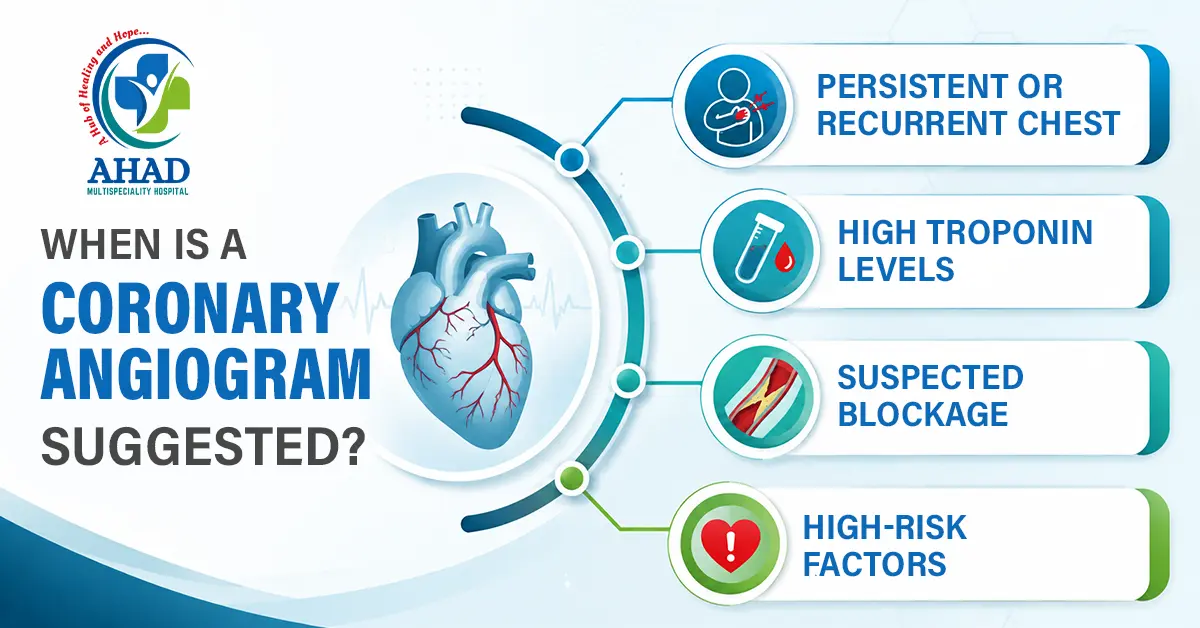
When is a coronary angiogram suggested?
A coronary angiogram is a specialised X-ray test that uses a special dye to show exactly where blockages are present in the coronary arteries and how severe they are. Doctors usually recommend a coronary angiogram in the following scenarios.
- Persistent or recurrent chest pain despite treatment.
- High troponin levels with major ECG changes.
- Suspected blockage or poor blood flow to a part of the heart.
- High-risk factors such as prior heart disease, family history of heart attacks and unstable angina.
Conclusion
Not every pain in the chest is a heart attack, but ignoring the discomfort is not advisable. Hence, recognise heart attack symptoms for timely evaluation in Bardhaman.